



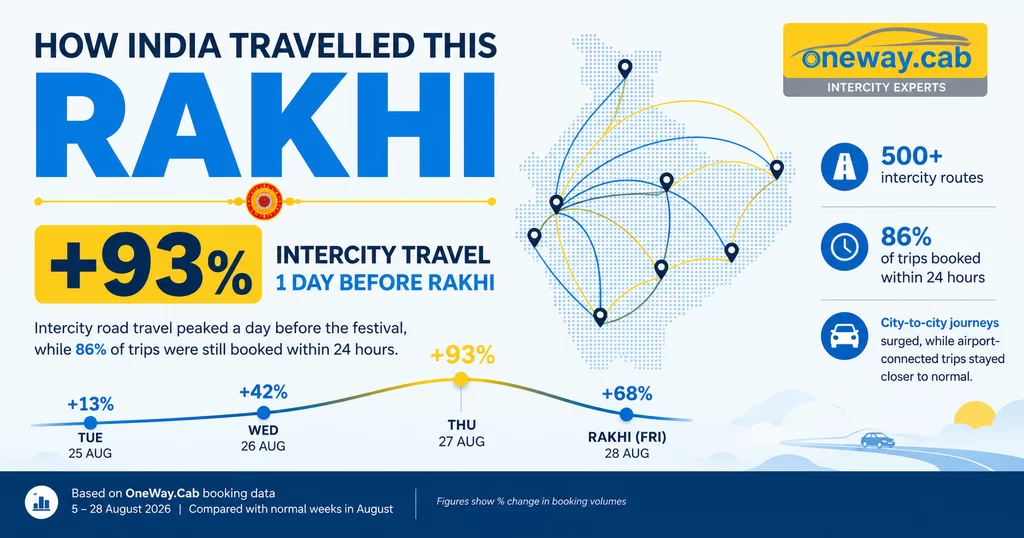
Pune, 31 August 2026 — The biggest intercity road travel surge around Raksha Bandhan came not on the festival itself, but a day earlier.
Intercity cab bookings on Thursday, 27 August — the day before Rakhi — were 93% above a normal Thursday, according to an analysis of booking data from intercity cab platform OneWay.Cab.
On Rakhi itself, Friday, 28 August, bookings remained elevated but eased to 68% above a normal Friday.
The pattern was not unique to 2026. In 2025, when Raksha Bandhan fell on a Saturday, OneWay.Cab again recorded its peak travel day on the Friday immediately preceding the festival.
“Rakhi creates an unusual travel clock,” said Vivek Kejriwal, CEO, OneWay.Cab. “If families want to be together for a morning ritual, the real travel day becomes the day before. What was particularly interesting was seeing the same pattern in 2025 as well, despite Rakhi falling on a different day of the week.”
The rush built for three days
The Rakhi travel surge developed progressively rather than arriving all at once.
Intercity bookings were 13% above normal on Tuesday, 25 August, rising to 42% above normal on Wednesday before jumping to 93% above normal on Thursday, the day before Rakhi.
On Friday, the festival day, the increase moderated to 68%.
The pattern suggests that for festivals centred around family gatherings and morning rituals, the strongest travel demand can occur before the festival rather than on the holiday itself.
Different year. Different weekday. Same behaviour.
Raksha Bandhan fell on different weekdays in 2025 and 2026, but the travel pattern remained consistent.
In both years, OneWay.Cab recorded its highest travel demand on the day immediately preceding Rakhi.
The repeat pattern suggests that the timing of the festival ritual may influence intercity travel behaviour more strongly than the particular weekday on which the festival falls.
Rakhi changed when people travelled — but barely changed when they booked
Despite the festival rush, travellers did not substantially increase how far in advance they planned their journeys.
During the Rakhi travel window, 86% of trips were booked within 24 hours of departure, including 53.3% booked on the same day.
That was remarkably similar to booking behaviour during normal August weeks.
There was, however, a noticeable shift among early planners. 13.6% of Rakhi trips were booked two or more days ahead, compared with approximately 9.7% during normal weeks — about a 40% increase in the share of advance bookings.
The data suggests that while a somewhat larger group planned the journey home earlier, the overwhelming majority continued to book close to departure.
The surge was city-to-city, not airport-led
The strongest increase was observed in city-to-city intercity journeys.
Bookings across home-city road corridors roughly doubled during the festival window, with several corridors recording substantially higher increases.
By comparison, OneWay.Cab journeys connected to airports remained much closer to normal levels.
The data indicates that the Rakhi surge on the platform was driven primarily by city-to-city road journeys rather than an equivalent increase in airport-connected cab travel.
Departures shifted earlier
Morning departures accounted for a larger share of journeys during the Rakhi period than during normal weeks, while overnight travel declined.
The shift is consistent with travellers adjusting their departure times around a festival centred on families gathering earlier in the day.
Methodology
The analysis is based on intercity cab bookings made through OneWay.Cab between 5 and 28 August 2026, covering more than 500 intercity routes.
Festival-period travel was compared with the average for the corresponding weekday during non-festival weeks in August. The Independence Day long weekend of 14–17 August and the Rakhi window were excluded from the baseline.
The 2025 comparison uses OneWay.Cab booking data around Raksha Bandhan 2025.
All percentage changes refer to booking volumes rather than absolute trip numbers. The findings represent travel behaviour observed on the OneWay.Cab platform and should be viewed as an indicator of intercity road-travel patterns rather than a national census.
About OneWay.Cab
OneWay.Cab is an intercity cab platform focused on one-way city-to-city and airport travel across India. The platform enables travellers to book fixed-fare intercity cab journeys through its website and app.
Media Contact OneWay.Cab press@oneway.cab
