



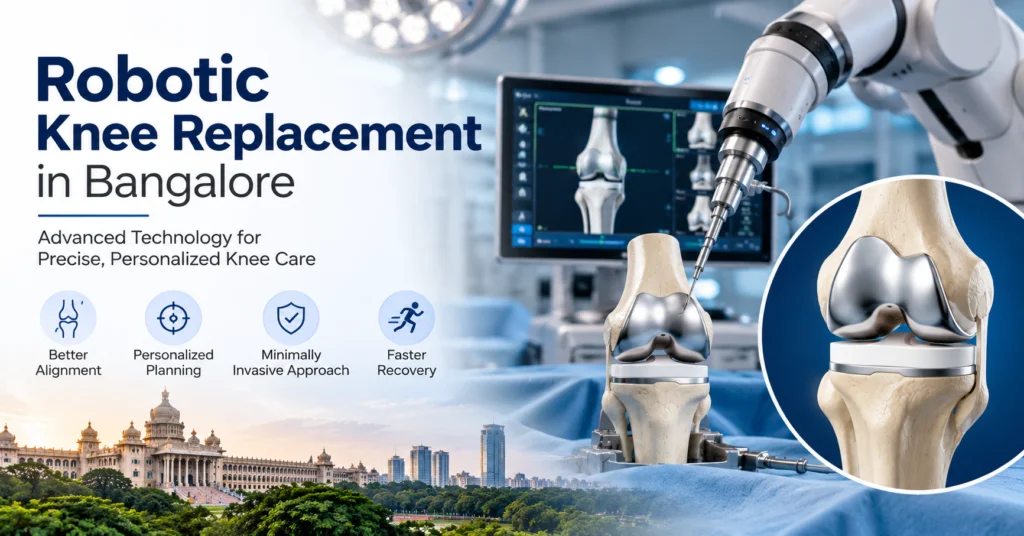
Sarjapur Road orthopaedic surgeon Dr. Nataraj H M, with 17 years of experience, explains who needs robotic knee replacement in Bangalore, how it works, recovery and risks.
Bengaluru, Karnataka, October 2026: As more people in Bangalore live with advanced knee arthritis, interest in robotic knee replacement has grown sharply. Dr. Nataraj H M, an orthopaedic surgeon and knee and shoulder specialist with 17 years of experience, is helping patients understand what the technology can and cannot do. He consults at 5 Sports Health, Carmelram, on Sarjapur Road.
What is robotic knee replacement?
Robotic knee replacement is knee replacement surgery assisted by a computer-guided robotic system. The system builds a 3D plan of the patient’s knee and guides selected steps such as bone preparation and implant positioning. The surgeon stays in full control and makes every clinical decision. It suits many, but not all, patients with advanced knee arthritis.
“Robotic assistance is a tool that supports precision. It does not replace a surgeon’s judgement, and it is not the right choice for every knee,” says Dr. Nataraj H M. “The first step is always a careful assessment of the patient, not the machine.”
Why knee arthritis is rising in Bangalore
Knee pain is no longer only an old-age problem in Bangalore. Long hours at desks, weekend cricket and running, rising body weight and an ageing population all add load to the knee. Over time, osteoarthritis wears away the cartilage that cushions the joint, and walking, climbing stairs and even sleeping can become painful.
Most patients start with non-surgical care such as exercise, physiotherapy, weight management and medicines. Knee replacement is considered when pain and stiffness persist despite these measures and daily life is clearly affected.
Who may need knee replacement surgery
A knee replacement specialist in Bangalore will usually consider surgery when a patient has advanced osteoarthritis with significant cartilage loss on X-ray, knee pain that disturbs sleep or limits walking distance, and difficulty climbing stairs or getting up from a chair. Other common reasons include a visible deformity, such as bow legs or knock knees, and little relief after months of proper non-surgical treatment.
Not every arthritic knee needs replacement. Joint-preservation options such as osteotomy, or a partial knee replacement, may suit some patients better.
How robotic-assisted knee replacement works
The exact steps vary with the robotic platform, but the process generally follows this order.
Step 1 – Assessment: The surgeon reviews symptoms, medical history, previous treatment, knee stability and overall health.
Step 2 – Imaging and digital planning: Imaging is used to create a patient-specific model of the knee.
Step 3 – Surgical plan: The surgeon plans alignment, implant size, implant position and bone cuts for that individual knee.
Step 4 – Guided surgery: In the operating room, the system gives real-time measurements and guides selected steps, keeping bone preparation within planned limits.
Step 5 – Implant placement: The surgeon fixes the implant, adjusting to what is found during surgery.
Step 6 – Rehabilitation: Physiotherapy focuses on walking, knee bend, muscle strength and balance.
Robotic vs conventional knee replacement
Robotic-assisted surgery uses a patient-specific 3D plan, real-time data on alignment and soft-tissue balance, and guided bone preparation. Conventional surgery uses standard measurements, manual cutting guides and the surgeon’s experience with traditional instruments. In both methods, the surgeon makes every decision, and the outcome depends on the patient, the surgeon, the implant and rehabilitation.
Conventional knee replacement also gives excellent results when well indicated and performed by an experienced surgeon. Robotics adds precision tools; it is not a separate treatment.
Partial or total knee replacement
A partial knee replacement replaces only the worn part of the knee when arthritis is limited to one area and the ligaments are healthy. A total knee replacement resurfaces the whole joint when damage is widespread. Robotic assistance can be used for selected cases of either type, depending on the pattern of arthritis, ligament condition and alignment.
Recovery after robotic knee replacement
Recovery is different for every patient. Early rehabilitation usually aims to get the patient walking safely with support, reduce swelling, regain knee bend and strengthen the thigh muscles. Strength, balance and endurance are then built up gradually with physiotherapy and home exercises.
Robotic assistance does not guarantee a faster recovery. General health, muscle strength before surgery and commitment to the exercise plan matter a great deal.
Risks patients should know
Robotic technology does not remove the standard risks of knee replacement. These include infection, blood clots, bleeding, stiffness, persistent pain, nerve or blood vessel injury, and implant wear or loosening that may need further surgery. Every patient should discuss benefits, risks, alternatives and expected recovery with their surgeon before deciding.
Why the surgeon matters more than the robot
The surgeon decides whether surgery is needed, whether robotic assistance suits the knee, which implant to use and how to respond to findings during the operation. That makes training and experience the most important factor in the result.
Dr. Nataraj H M has 17 years of orthopaedic experience. According to his clinic, he has performed over 2,000 knee replacements, over 2,000 knee arthroscopies and over 1,000 shoulder arthroscopies, and has treated more than 30,000 patients.
He completed his MBBS at Kempegowda Institute of Medical Sciences (KIMS), Bangalore, and his MS in Orthopaedics at K S Hegde Medical Academy, Mangalore. He also holds an MCh Ortho from the American Institute of Medicine, University of Seychelles. His fellowships include advanced shoulder and knee surgery at Concordia Hospital, Italy, arthroscopy and sports medicine through ISAKOS, and computer-assisted joint replacement through ISHKS.
He is credited with several firsts, including the first computer-navigated total shoulder replacement in India and the first arthroscopic meniscal repair in Southeast Asia using the Zimmer-Biomet all-suture device. He also focuses on non-surgical care and joint-preservation procedures that can delay or avoid replacement, and has delivered guest lectures at orthopaedic conferences.
Robotic knee replacement consultations on Sarjapur Road
Patients looking for a knee replacement surgeon in Bangalore can consult Dr. Nataraj H M at 5 Sports Health, Site No. 40 & 41, 1st Floor, MPS Building, Ambedkar Nagar, Mullur, Sarjapur Road, Carmelram, Bangalore, Karnataka 560035. Consultation hours are Monday to Saturday, 3:00 PM to 8:00 PM. Appointments can be booked on +91 93804 43139 (phone and WhatsApp).
The Carmelram clinic is convenient for patients from Sarjapur, Dommasandra, Varthur, Bellandur, HSR Layout, Marathahalli, Whitefield, Electronic City and Koramangala. Patients from across Karnataka and other states also travel to Bangalore for evaluation.
About Dr. Nataraj H M
Dr. Nataraj H M is an orthopaedic surgeon and sports medicine specialist in Bangalore who specialises in knee and shoulder care, with 17 years of experience. His practice covers computer-assisted and robotic-assisted knee replacement, partial and total knee replacement, knee and shoulder arthroscopy, sports injuries, ligament reconstruction, fracture care and joint preservation. He consults at 5 Sports Health, Carmelram, Sarjapur Road, Bangalore.
Media contact
Dr. Nataraj H M
5 Sports Health, Sarjapur Road, Carmelram, Bangalore 560035
Phone: +91 93804 43139
Email: Kneeandshoulder2000@gmail.com
Website: www.kneeandshoulder.net
Disclaimer: This article is for general information only and is not a substitute for medical advice. Suitability for robotic or conventional knee replacement can only be decided after a personal consultation with a qualified orthopaedic surgeon. Outcomes vary between patients.
